WhatsApp:(+86)18620951155
Phone:(+86)020-29065322
Email:yangst@yangst.com
Address:NZRD56,Lianhu,Shatou,Panyu,GZ

Email:yangst@yangst.com

WhatsApp:(+86)18620951155
Phone:(+86)020-29065322
Email:yangst@yangst.com
Address:NZRD56,Lianhu,Shatou,Panyu,GZ
The EN standard is a European standard, published as a formal document in June 2005. EN 1004 is the European standard covering the design, manufacture, testing and use of mobile access towers and working platforms. It replaced HD 1004.
In the early days, as European construction developed, mobile scaffolding ran into two serious problems:
1) Manufacturers of mobile towers and platforms prefabricated or assembled their products with four legs and castors in a seriously unsafe condition;
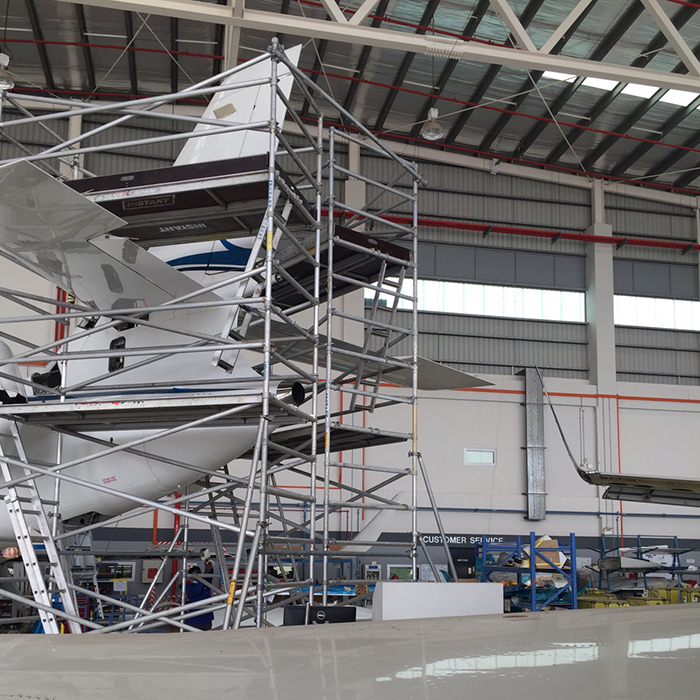
2) Ladder manufacturers moving into aluminium mobile work platforms on castors found the same unsafe factors.
CEN/TC 53 therefore decided in 1980 to draw up a standard for mobile scaffolds and platforms, set at the same level as the European scaffold standards EN 12810-2 and EN 12811-3. With continued refinement, EN 1004:2004 is the current version.
Under the internal rules of CEN/CENELEC, the national standards bodies of the following countries implement this standard: Austria, Belgium, Cyprus, the Czech Republic, Denmark, Estonia, Finland, France, Germany, Greece, Hungary, Iceland, Ireland, Italy, Latvia, Lithuania, Luxembourg, Malta, the Netherlands, Norway, Poland, Portugal, Slovakia, Spain, Sweden, Switzerland and the United Kingdom.
Mobile aluminium scaffolding
Mobile aluminium scaffolding is one product form of mobile access tower, designed and built strictly to EN 1004.
EN 1004 applies to the design of mobile towers with working heights from 2.5 m to 12.0 m indoors and from 2.5 m to 8.0 m outdoors.
The standard covers:
- guidance on the choice of principal dimensions and stabilisers;
- safety and performance requirements;
- information on complete working platforms.
Its tests include:
- overall structural dimensions (platform deck size, clear height, guardrail dimensions, ladder rung spacing and so on)
- castor testing
- testing of the most unfavourable load combination on the structure (sample height not exceeding 3 m)
- uniformly distributed platform load (Class 2 or Class 3)
- deflection of platform components under load
- deflection of guardrails under load
- tilt angle of the assembled vertical components
- overall structural stiffness test
Note: in this document "indoor" means the platform is not exposed to wind, and "outdoor" means it may be exposed to wind.
Scaffold platform standards in the main regions
1. Europe - general scaffolds: EN 74-1:2005; mobile scaffolds: EN 1004:2004
2. Australia / New Zealand: AS/NZS 1576.2:2009
3. China: GB 51210-2016, which contains no standard for mobile scaffolds
4. United States: ANSI/SSFI SC100-5/05
5. Canada: CAN/CSA-S269.2-M87:2003
Every YANGST aluminium scaffold is built strictly to EN 1004, WAHR, ANSI and related standards, meeting the design and safety requirements of the great majority of countries worldwide. The YANGST SPAN400 aluminium scaffold is designed and tested to the highest class, Class 3 - safe, stable and durable.

WhatsApp:(+86)18620951155
yangst@yangst.com
56 NZRD,Lianhu,Shatou,Panyu,GZ

