WhatsApp:(+86)18620951155
Phone:(+86)020-29065322
Email:yangst@yangst.com
Address:NZRD56,Lianhu,Shatou,Panyu,GZ

Email:yangst@yangst.com

WhatsApp:(+86)18620951155
Phone:(+86)020-29065322
Email:yangst@yangst.com
Address:NZRD56,Lianhu,Shatou,Panyu,GZ
In nuclear construction - one of the most demanding engineering fields in the world - the working environment inside the reactor containment is known for cramped space, complex structure and severe safety standards. As nuclear construction moves towards modularisation and precision, conventional steel tube scaffolding is being replaced by high-strength aluminium scaffold systems, because steel is heavy, slow to erect and prone to rust contamination.
Radiological cleanliness. Materials inside a nuclear plant must be highly corrosion resistant and clean at the surface. Conventional steel frames rust, and falling rust particles can disturb the clean operating environment of precision instruments.
Restricted space and irregular geometry. The containment is filled with pressure vessel supports, penetrations of every kind and the polar crane rail. The working space is extremely irregular, so the scaffold must be highly adaptable.
Floor loading limits. At some stages the working platform is built on embedded parts or thin-wall structures, which places strict limits on the self-weight of the scaffold.
Programme pressure and zero tolerance on safety. Every day of progress on a nuclear project carries enormous cost, and work at height must meet a zero-accident standard.
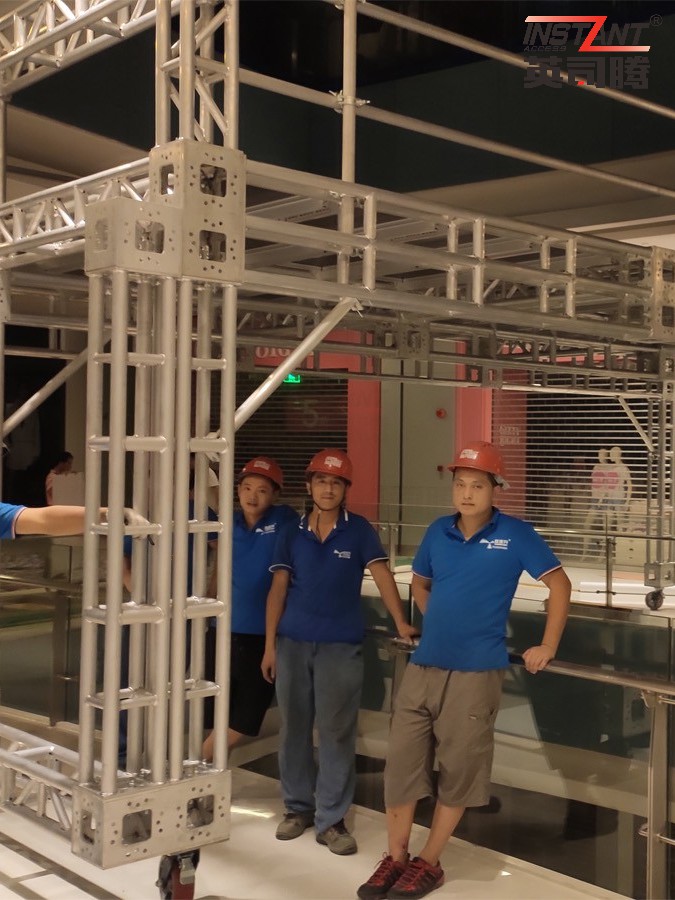
Inside containment, operatives often have to work around the massive reactor pressure vessel or across complex pipework. With non-standard modules such as bridges and cantilevered platforms, aluminium scaffolding builds a bridge in mid-air with ease.
Applications: installing the polar crane beam, welding penetrations, spraying inside the containment shell.
Aluminium has about one third the density of steel. In the narrow passages of containment, workers can carry components by hand without heavy lifting equipment.
Effect: for the same working area, an aluminium scaffold erects more than 60% faster than a steel scaffold, greatly shortening the critical path.
Aluminium is naturally corrosion resistant, produces no rust and is non-magnetic. This matters for commissioning precision instruments and for non-destructive testing inside a nuclear plant, where it causes no electromagnetic interference with processes such as magnetic particle inspection.
Nuclear-grade aluminium scaffolds generally use 6082-T6 aerospace-grade aluminium. Joints are usually made by cold pressing - as in YANGST technology - or by high-precision robotic welding, so that under long-term vibration the joints neither loosen nor crack, and load capacity fully meets EN 1004 Class 3.
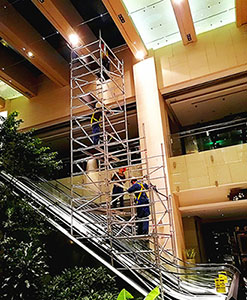
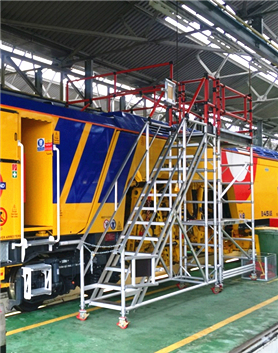
3.1 Combined mobile platforms for inspecting the containment wall and installing sensors. Heavy-duty swivel castors at the base let the platform move quickly over a level floor, and a linked braking system keeps it firm while work is carried out.
3.2 Cantilevered platforms for irregular geometry. Where large equipment in the middle of the containment prevents the scaffold from being founded on the floor, the light weight of aluminium allows a "hung above, propped below" approach: a cantilevered platform is extended from existing steelwork or embedded parts, solving the problem of having nowhere to stand a tower.
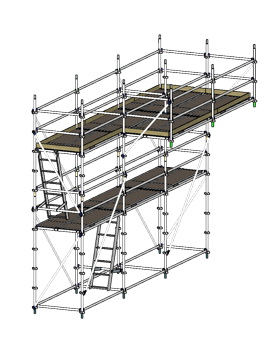
3.3 Annular working platforms at the top of the containment. For work around the ring at the top of the containment, modular curved aluminium frames follow the curvature of the wall precisely and give operatives a fully enclosed working face with toe boards.
In an extreme field such as nuclear, a manufacturer's technical depth is the precondition for safety. YANGST cold-pressed joints are widely used in nuclear work, not only for structural strength but because a non-welded structure shows excellent fatigue life in a nuclear environment.
Aluminium scaffolding inside reactor containment is more than a change of material: it is a shift in construction logic from heavy manual work and low efficiency towards precision and modularisation. As China's third-generation nuclear technology - Hualong One and CAP1400 - is built at scale, highly flexible, highly safe aluminium working platforms will become standard equipment in nuclear construction.

WhatsApp:(+86)18620951155
yangst@yangst.com
56 NZRD,Lianhu,Shatou,Panyu,GZ

