WhatsApp:(+86)18620951155
Phone:(+86)020-29065322
Email:yangst@yangst.com
Address:NZRD56,Lianhu,Shatou,Panyu,GZ

Email:yangst@yangst.com

WhatsApp:(+86)18620951155
Phone:(+86)020-29065322
Email:yangst@yangst.com
Address:NZRD56,Lianhu,Shatou,Panyu,GZ
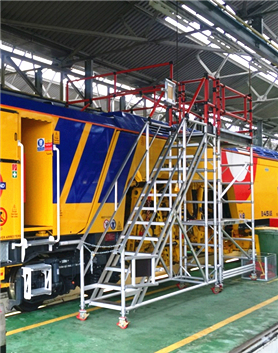
Modern technology develops quickly and new materials keep appearing; high-strength aluminium alloys in particular are now used far more widely. As the performance of aluminium quick-assembly scaffolding becomes better known, it is increasingly used in China by enterprises, hotels and cleaning contractors for equipment maintenance and cleaning. YANGST supplies the INSTANT aluminium ranges: SPAN400, SPAN500, SPAN400-S, SPAN400-D, SPAN500-S, SPAN500-D and TVX.
Inadequate training by suppliers, together with rapid turnover of site labour, means that some risks remain in use. The main points to watch are set out below.
Before erection: checks
1. Check all components - nothing damaged; replace or top up missing parts immediately.
2. Check the welds - no weld should have started to fail.
3. Check the tubes - no cracks, and no dents from crushing or impact. Any tube with a dent deeper than 5 mm must not be used.
4. Keep the thread of the adjustable legs clean and oiled.
Load limits
The maximum overall load of each scaffold set is 750 kg, and the maximum load on a single platform deck is 250 kg.
Moving the scaffold
- Everyone must leave the scaffold, and all loose material must be cleared from the platform and from the ground;
- Push the scaffold from its base, never pull it from the top;
- Watch for live cables and other obstructions;
- On slopes or uneven ground take care with the castor locks;
- While moving, the height must not exceed 2.5 times the smallest base dimension - a 9 m tower must be lowered to 7.5 m before it is moved;
- When the scaffold is not being moved, every castor must be locked and all accessories laid flat on the ground.
Using the scaffold
- Watch for strong winds and gusts outdoors. Stop work when wind speed exceeds 7.9 m/s (above force 4); tie the scaffold rigidly to a solid structure above 13.8 m/s (above force 6); dismantle it in advance if wind may exceed 18 m/s (above force 8). Beware of wind eddies around buildings.
- No high-voltage cables or other obstructions may be present in the working area.
- Do not misuse components, especially damaged ones or ones of the wrong specification.
- Raise or lower components, tools and materials on a rope inside the base of the scaffold, and do not exceed the platform or tower load limits.
- A fully erected scaffold is a working platform, not a walkway.
- Horizontal forces, such as those from power tools, can make the tower unstable.
- Use a stairway when tools or materials are carried up frequently.
Height-to-base ratio
Indoors, the platform height must never exceed 3.5 times the platform width; outdoors with no wind, never more than 3 times the width, and outdoors the limit must be applied strictly. Fitting ST1 standard outriggers indoors raises the effective width to 3.47 m and the maximum height to 12.15 m; ST2 large outriggers outdoors raise the effective width to 5.83 m and the maximum height to 17.5 m.
The ground
Before work starts, check the ground and the surrounding area:
- the ground must be level
- no steps (unless specifically required)
- no gaps
- all debris cleared
- watch for tall hazards
- ceiling height
- beams
- suspended items
- cables and the like

WhatsApp:(+86)18620951155
yangst@yangst.com
56 NZRD,Lianhu,Shatou,Panyu,GZ

