


WhatsApp:(+86)18620951155
Phone:(+86)020-29065322
Email:yangst@yangst.com
Address:NZRD56,Lianhu,Shatou,Panyu,GZ

Email:yangst@yangst.com

WhatsApp:(+86)18620951155
Phone:(+86)020-29065322
Email:yangst@yangst.com
Address:NZRD56,Lianhu,Shatou,Panyu,GZ
A nuclear power station is a high-risk, high-technology energy facility, and its routine maintenance and outages demand extremely strict levels of safety, efficiency and cleanliness. During an outage a great deal of work at height - inspection and repair in the reactor building, turbine hall, boiler internals, and on hydro generator stators and rotors - depends on access platforms. Conventional steel tube and coupler scaffolding is heavy, slow to erect and strike, and sheds rust and debris, so it no longer fully meets the requirements of modern nuclear maintenance.
Industrial-grade quick-assembly aluminium scaffold systems such as INSTANT by YANGST, with their light weight, high strength without welding, fast assembly and high safety compliance, are becoming the preferred solution for work at height in nuclear plant maintenance. This article sets out the core advantages of aluminium scaffolding in nuclear maintenance and provides a practical selection guide.
Work at height in a nuclear plant demands exceptional stability. On industrial aluminium scaffolding such as YANGST products, the standards and joints perform very well mechanically, with tensile strength of 315 MPa or more.
Cold pressing instead of welding. Nuclear plants are extremely sensitive to material defects, and welds are where fatigue cracks and hazards begin. Modern industrial aluminium scaffolding generally uses the Rib-Grip cold expansion and cold pressing technique: the main tower has no welds at all and the rungs carry no diagonal ribs. The pull-out force of this three-way cold-pressed joint reaches 6 tonnes, three times the strength of a conventional welded joint, removing the risk of failure from a weld defect.
Double locking. Ledgers have a spring-loaded self-locking hook that clips into place without pre-alignment; the hook engages over more than 225 degrees, and together with the wind lock on the platform deck it copes with strong indoor air movement or complex outdoor conditions, giving a whole-scaffold capacity of not less than 900 kg and a safe working load of 360 kg on one platform level.
Nuclear plants - especially inside the nuclear island and around the reactor - enforce very strict foreign material exclusion (FME) control.
No rust, no iron particles. Conventional steel scaffolding produces rust, paint flakes and steel particles as it is erected and struck, which can contaminate precision instruments or loop systems. Aluminium scaffolding has an oxidation-resistant surface, is free of inclusions and defects, is highly corrosion resistant and never rusts.
Interchangeable parts and good cleanliness. Tube surfaces are smooth, so radioactive dust and dirt do not collect, decontamination is easy, and the scaffold can be cycled back into controlled areas repeatedly.
Every day of a nuclear outage carries enormous economic cost, so maintenance efficiency is critical.
Light. Aluminium weighs about one third as much as steel, and about 60% less than an iron scaffold. Floor loading is low, and the physical effort of handling is greatly reduced.
Assembled by hand. Aluminium quick-assembly scaffold needs no tools. With standardised parts, Z-bracing and self-locking hooks, a small mobile tower is usually up in about ten minutes with two workers - more than 70% faster than conventional scaffolding, greatly compressing the programme.
Nuclear procurement looks hard at long-term return. A high-quality industrial aluminium scaffold is designed for a service life of 30 years or more. Leading brands such as YANGST offer a 10-year warranty, with free replacement within ten years for any quality problem, so the cost per use over the whole life is far lower than iron scaffolding that needs frequent maintenance and replacement.
In the complex maintenance environment of a nuclear plant, different conditions, areas and equipment place different demands on the scaffold. To ensure purchasing and use are absolutely safe and efficient, follow these principles.
When special equipment is brought onto a nuclear project, safety certification is the first threshold. The product must be designed to EN 1004 / WAHR, with test and safety reports from a recognised body such as the original German TUV or GS. A compliant product gives firm safety baselines for guardrail height (not less than 1.1 m), toe board provision and load per platform level (not less than 360 kg).
Space inside a nuclear plant varies enormously, from a cramped valve repair to the inside of a large boiler, so the structure must suit the place:
Under EN 1004, mobile platform access is classified by grade, and a nuclear plant should pay particular attention to how people get up and down:
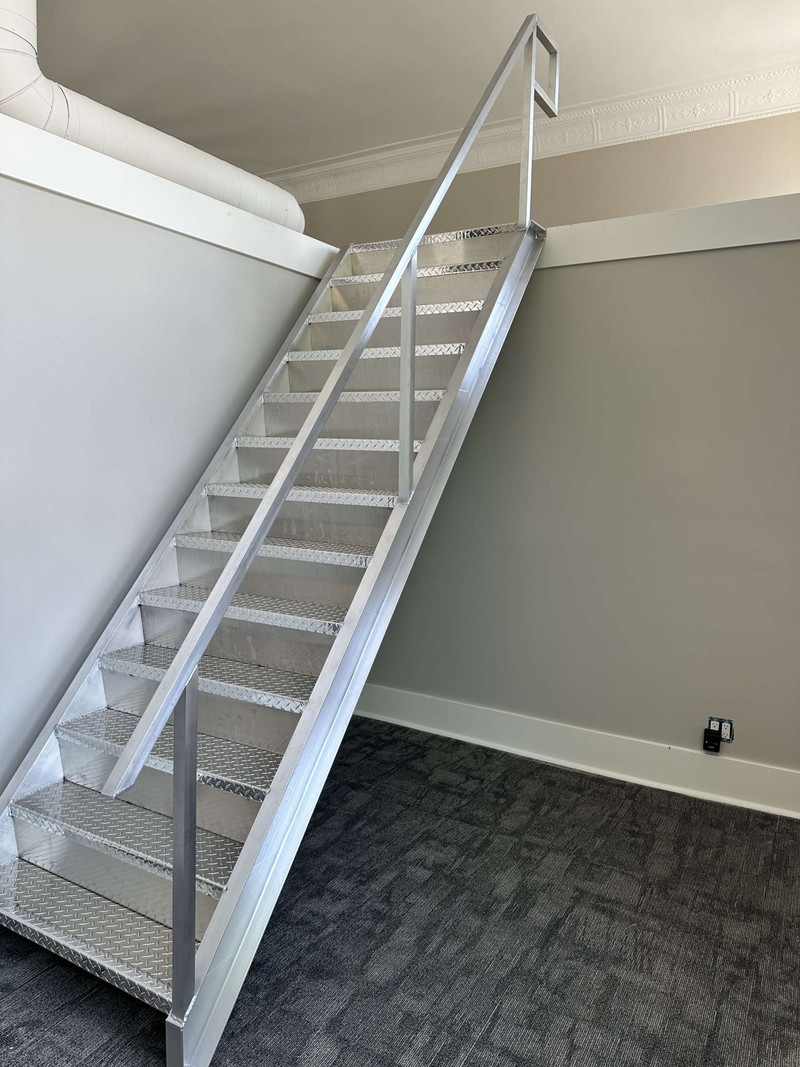
Avoid or minimise plain vertical ladders. For routine nuclear maintenance, fit a 45-degree stairway: treads should be slip-resistant boards at least 80 mm wide, with self-locking hooks to prevent loosening and falling. For operatives who must carry precision instruments or move items under 20 kg up and down frequently, a stairway with handrails gives far better protection against a fall.
Nuclear plant floors often carry expensive anti-static coatings or special epoxy finishes. The feet of the outriggers must be full-face pads with anti-slip provision, so the tower stays firm at height and sway is reduced.
Mechanical adjustable legs at the base should be light and simple, able to sit steadily on the rough or sloping ground found on nuclear sites. High-performance polyurethane castors with twin brakes let the whole tower be moved easily while protecting the floor from scratching and crushing.
Safety is the lifeline of nuclear power, and efficiency is the core aim of an outage programme. With their combination of high strength, no welding, light and clean material and hand assembly, aluminium quick-assembly scaffolds solve precisely the secondary contamination risk and the inefficiency of conventional iron scaffolding. In future outages and routine maintenance, following a sound selection guide and adopting a professional aluminium scaffold system will build a firm barrier of safety for the stable, reliable and efficient operation of nuclear energy.

WhatsApp:(+86)18620951155
yangst@yangst.com
56 NZRD,Lianhu,Shatou,Panyu,GZ

